
An AI agent builder is a platform that lets people create autonomous or semi autonomous AI systems, called agents, capable of completing multi step tasks on their own rather than simply responding to a single question. Unlike a basic chatbot that answers one message at a time, an agent built through this kind of tool can plan a sequence of actions, use external tools like databases or APIs, and work through a task with limited human intervention along the way. This guide explains what an AI agent builder actually does, how it differs from simpler AI tools, and why adoption has grown so quickly across businesses of every size.
What Makes an Agent Different From a Chatbot
A traditional chatbot receives a message and generates a single response based on that input. An agent built with an AI agent builder works differently: it can break a broader goal into smaller steps, decide which tools or data sources it needs to complete each step, execute those steps in sequence, and adjust its approach based on the results it gets along the way. A chatbot answers a question about a customer's order status. An agent could actually look up the order, check shipping status through a connected system, and send an update email, all without a human manually performing each individual step.
This distinction matters enormously for what kinds of problems each tool can realistically solve. Chatbots excel at answering questions and holding conversations. Agents excel at completing processes that involve multiple steps, decisions and tool usage.
The Core Components of an AI Agent Builder
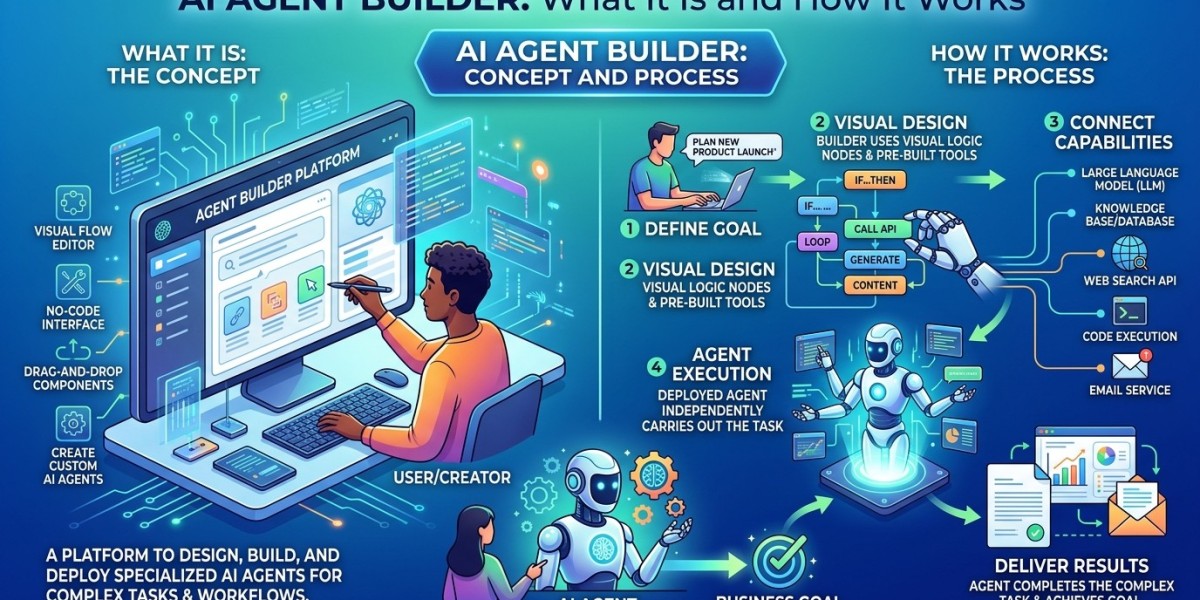
Most platforms in this category share a similar underlying structure, even though the interface and specific features vary. An AI agent builder typically provides a way to define the agent's goal or role, a way to connect external tools and data sources the agent can use, a mechanism for the agent to plan and sequence its own actions, and some form of memory or context tracking so the agent remembers relevant information across the steps of a task.
Many platforms also include guardrails, ways to limit what actions an agent can take without human approval, which matters significantly once an agent has real access to systems like email, databases or payment processing.
Why Businesses Are Adopting Agent Builders Quickly
Interest in AI agent builder platforms has grown rapidly because the potential impact is significant: tasks that previously required a human to manually check a system, retrieve information, make a decision and take an action can increasingly be handled by an agent working through the same steps automatically. Customer support teams use agents to handle routine inquiries end to end. Sales teams use them to research leads and draft personalized outreach. Operations teams use them to monitor systems and trigger responses to specific conditions without constant human oversight.
The appeal of a modern AI agent builder specifically is accessibility. Earlier versions of this kind of automation required custom engineering work, while current platforms let non technical team members define an agent's behavior through natural language instructions or visual workflow builders, dramatically lowering the barrier to building something genuinely useful.
How an Agent Actually Executes a Task
When an agent built through an AI agent builder receives a task, it typically follows a loop: interpret the goal, decide what action or tool to use next, execute that action, observe the result, and decide whether the goal has been achieved or another step is needed. This loop continues until the task is complete or the agent reaches a point where it needs human input, either because it lacks confidence in how to proceed or because the action requires approval under whatever guardrails have been configured.
This looping, decision making behavior is what separates true agents from simple automation scripts. A basic automation follows a fixed, predetermined sequence of steps every time. An agent adapts its sequence of steps based on what it encounters during execution, which makes it more flexible but also introduces more unpredictability that needs to be managed carefully.
Common Use Cases Across Industries
Across different industries, AI agent builder platforms are being used for customer support automation, where an agent handles common inquiries and escalates only genuinely complex cases to a human. Sales and marketing teams use agents for lead research, outreach drafting and CRM updates. Operations and IT teams use agents for system monitoring, incident triage and routine maintenance tasks. Internal knowledge work, such as research summarization and report generation, has also become a common application as agents grow more capable of working across multiple documents and data sources.
Where Agent Builders Still Have Limits
Despite rapid progress, an AI agent builder is not yet a replacement for human judgment on genuinely ambiguous or high stakes decisions. Agents can misinterpret an unclear goal, get stuck in a loop when a task does not fit their expected pattern, or take an action that seems reasonable to the system but is wrong in a specific business context the platform was never told about. Effective use of any AI agent builder still requires clear task definition, appropriate guardrails, and ongoing monitoring, at least until an agent has a proven track record on a specific, well scoped task.
Final Thought
An AI agent builder represents a meaningful step beyond simple chatbots, giving teams the ability to automate genuinely multi step processes rather than single question interactions. Understanding how agents plan, use tools and loop through execution helps set realistic expectations, and choosing well scoped, well guarded tasks for early agent projects is what separates teams who get genuine value from these platforms from those who end up disappointed by overreaching too quickly.