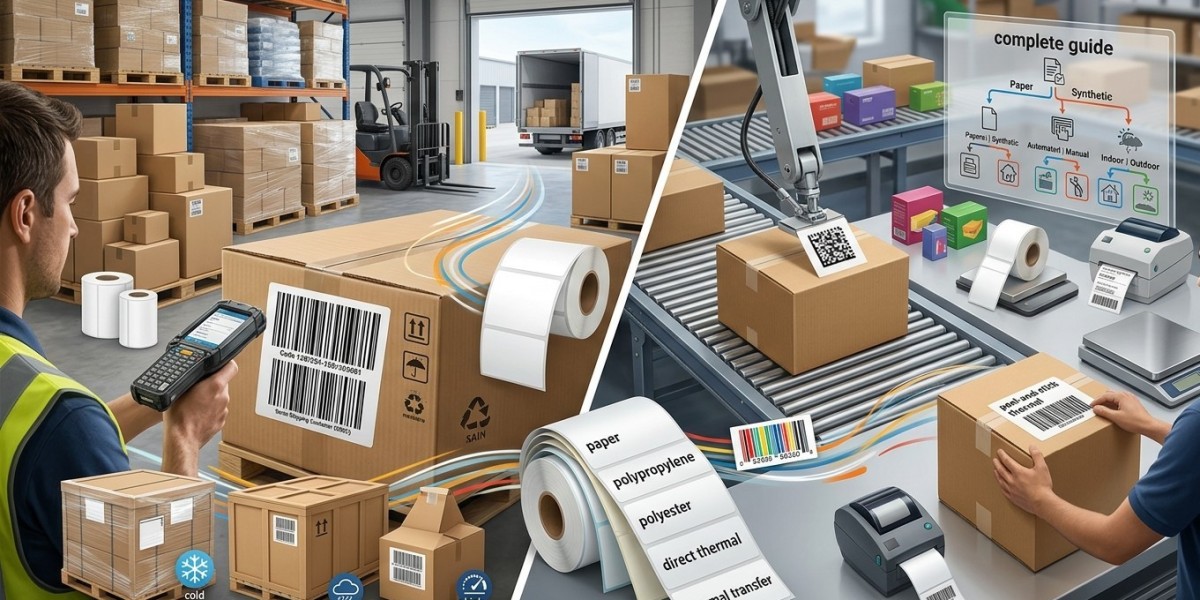

Shipping and packaging operations depend on accurate product identification, tracking, and data collection. From small parcels and retail products to cartons, pallets, and large shipments, businesses need labels that remain readable throughout the entire logistics process. A properly selected barcode label can help warehouses scan products faster, reduce shipping mistakes, and improve visibility across the supply chain.
For businesses looking for reliable barcode and identification solutions, Pointus Solutions provides technologies designed to support modern warehouse, retail, logistics, and supply chain operations. Whether you want to Shop Barcode printers, scanners, labels, ribbons, or other Printing Products, choosing the right barcode label is an important step toward creating an efficient shipping and packaging process.
Why Barcode Labels Are Important for Shipping and Packaging
Barcode labels provide products and packages with a machine-readable identity. Instead of manually entering product numbers, employees can scan a barcode and retrieve the associated information from an inventory, warehouse, order management, or shipping system.
In shipping and packaging, barcodes can be used to identify:
- Individual products
- Boxes and cartons
- Shipping packages
- Pallets
- Purchase orders
- Sales orders
- Customer shipments
- Batch and lot numbers
- Serial numbers
- Tracking information
A reliable barcode label helps ensure that the correct product reaches the correct destination. It also improves communication between manufacturers, warehouses, distributors, retailers, and logistics providers.
What Should You Consider When Choosing Barcode Labels?
There is no single barcode label that is ideal for every shipping and packaging application. The right choice depends on several factors, including the packaging material, environment, label size, printing method, barcode type, and expected lifespan.
Before purchasing labels, businesses should evaluate the following considerations.
1. Choose the Right Barcode Type
The first step is determining which barcode format is appropriate for your application.
1D Barcodes
One-dimensional barcodes consist of lines and spaces and are widely used for product identification and shipping applications.
Common examples include:
- Code 39
- Code 128
- EAN
- UPC
- ITF
- GS1-128
1D barcodes are useful when businesses primarily need to encode a product or identification number.
2D Barcodes
Two-dimensional barcodes store information using patterns of squares or other graphical elements.
Examples include:
- QR Codes
- Data Matrix
- PDF417
2D barcodes can store more information in a relatively small area, making them useful for applications where space is limited or additional data needs to be encoded.
The barcode type should always be selected according to the requirements of your inventory, warehouse, shipping, and customer systems.
2. Select the Appropriate Label Material
The material of a barcode label directly affects its durability and performance.
For standard indoor shipping operations, paper labels may be sufficient. They are economical and suitable for many boxes, cartons, and packages.
However, more demanding applications may require synthetic materials such as:
- Polyester
- Polypropylene
- Other durable synthetic label materials
These materials can provide greater resistance to moisture, abrasion, chemicals, and handling.
For example, a package traveling through multiple warehouses and transportation environments may experience more wear than a product stored in a controlled indoor facility.
3. Consider the Shipping Environment
Before choosing a label, think about the conditions the package will experience.
Will the label be exposed to:
- Rain or moisture?
- Extreme temperatures?
- Dust?
- Direct sunlight?
- Chemicals?
- Friction?
- Rough handling?
- Refrigeration or freezing?
If packages are transported outdoors or stored in cold environments, standard paper labels may not always provide the required durability.
Selecting a label based on the actual environment can help ensure that the barcode remains readable throughout its journey.
4. Choose the Correct Label Size
Barcode labels come in many sizes, and the right size depends on the package and the amount of information that needs to be displayed.
A label should be large enough to accommodate:
- Barcode
- Product or shipping number
- Human-readable information
- Address details where required
- Batch or serial information
- Additional shipping information
At the same time, the label should not be unnecessarily large.
For small products, compact labels may be more appropriate. Large cartons and shipping containers can accommodate larger labels that are easier to scan from a distance.
5. Pay Attention to Barcode Print Quality
A barcode is only useful if scanners can read it accurately.
Poor print quality can result in:
- Failed scans
- Slower warehouse operations
- Manual data entry
- Shipping delays
- Inventory errors
- Increased labor costs
Barcode labels should have clear, sharp bars or modules and sufficient contrast between the barcode and its background.
The printer, label material, ribbon, print settings, and maintenance practices all contribute to the final barcode quality.
Thermal Transfer vs. Direct Thermal Labels
One of the most important decisions when choosing barcode labels is selecting the appropriate printing technology.
Direct Thermal Labels
Direct thermal printing uses heat-sensitive material. The printer's thermal printhead creates the image directly on the label.
Advantages include:
- No ribbon required
- Simple operation
- Lower consumable complexity
- Fast printing
Direct thermal labels are often suitable for short-term shipping labels and applications where labels do not need to remain exposed for extended periods.
Thermal Transfer Labels
Thermal transfer printing uses a ribbon to transfer ink onto the label material.
Benefits can include:
- Long-lasting print
- Better durability
- Resistance to environmental conditions
- Compatibility with a wide range of label materials
Thermal transfer labels are often suitable when shipping or packaging labels need to remain readable for longer periods or face more demanding conditions.
The right choice depends on the application, expected label lifespan, and environmental requirements.
Choosing the Right Adhesive
The adhesive is another important factor that is sometimes overlooked.
A barcode label must remain attached to its package throughout handling, transportation, storage, and delivery.
Consider whether the label will be applied to:
- Corrugated cardboard
- Plastic
- Glass
- Metal
- Wooden surfaces
- Shrink-wrapped packaging
- Textured surfaces
Different surfaces may require different adhesive characteristics.
A label that works well on cardboard may not perform equally well on a smooth plastic container. Businesses should therefore test adhesive performance before implementing labels on a large scale.
Barcode Labels for Cartons and Shipping Boxes
Carton labels are commonly used in warehouses and distribution centers to identify packages during receiving, storage, picking, packing, and shipping.
A carton label may contain:
- Product number
- Quantity
- Order number
- Batch number
- Shipping information
- Barcode
- Human-readable product information
The label should be placed where warehouse employees and automated scanning systems can easily access it.
Consistent placement also makes scanning faster and reduces confusion during high-volume operations.
Barcode Labels for Pallets
Pallets often require larger labels because they may need to be scanned from greater distances.
Pallet labels can connect multiple individual cartons to a single shipment or logistical unit.
This allows warehouse teams to track:
- Pallet identification
- Shipment number
- Destination
- Product contents
- Quantity
- Batch information
Businesses handling large shipping volumes can benefit from standardized pallet labeling procedures.
Human-Readable Information Matters
Although barcode scanning is automated, human-readable information should not be ignored.
A good barcode label should provide enough visible information for employees to identify the package if scanning equipment is temporarily unavailable.
Human-readable details may include:
- Product name
- Product code
- Quantity
- Order number
- Destination
- Serial number
- Batch number
This creates an additional layer of usability and helps employees resolve scanning or identification issues more quickly.
Label Placement and Scanning Efficiency
Choosing the correct label is only part of the process. Proper placement is equally important.
Avoid placing barcode labels:
- Over package seams
- On heavily curved surfaces
- Near damaged edges
- Where tape can cover the barcode
- In locations likely to be scratched
- Where folds or wrinkles can distort the label
For boxes and cartons, labels should generally be placed on flat, accessible surfaces.
Consistent placement helps warehouse workers find and scan barcodes quickly.
How Barcode Labels Improve Shipping Accuracy
Barcode labels can significantly reduce manual data entry during shipping.
A typical process may involve:
- Picking the product.
- Scanning the product barcode.
- Confirming the order.
- Packing the product.
- Printing or applying the shipping label.
- Scanning the package before dispatch.
- Recording the shipment in the system.
Each scan creates an opportunity to verify that the correct product and shipment are being processed.
This helps reduce errors such as shipping the wrong product, incorrect quantities, or sending packages to the wrong destination.
Common Barcode Label Mistakes to Avoid
Businesses should avoid several common mistakes when selecting and using shipping labels.
Using the Wrong Material
A standard paper label may fail in environments involving moisture, heat, freezing, or heavy abrasion.
Poor Print Quality
Low-quality printing can create unreadable barcodes.
Incorrect Label Size
Barcodes that are too small may be difficult for scanners to read reliably.
Poor Placement
Labels applied over seams, folds, or curved surfaces can create scanning problems.
Incompatible Printer and Media
The printer, label material, ribbon, and print settings should work together correctly.
Ignoring Customer Requirements
Some retailers, distributors, and logistics partners may have specific barcode formats, label sizes, or data requirements.
Best Practices for Shipping and Packaging Barcode Labels
To get the best results from barcode labeling, businesses should follow a consistent process.
1. Standardize label formats: Use consistent layouts throughout your warehouse.
2. Select durable materials: Match label construction to the shipping environment.
3. Maintain barcode printers: Regularly clean and inspect printheads.
4. Test barcode readability: Scan sample labels before large-scale production.
5. Train warehouse employees: Make sure staff understand proper label placement and scanning procedures.
6. Use reliable scanners: Select scanners that match your barcode types and working distances.
7. Integrate with business software: Connect barcode scanning with inventory and shipping systems.
8. Monitor recurring errors: Investigate failed scans and identify their root causes.
How to Choose the Right Barcode Label Supplier
A reliable supplier should provide more than just labels. Businesses should look for a provider that understands their complete barcode and identification requirements.
Consider:
- Label material options
- Custom label sizes
- Barcode printing requirements
- Printer compatibility
- Ribbon compatibility
- Scanner compatibility
- High-volume availability
- Technical support
- Industry experience
Working with a knowledgeable supplier can make it easier to select the right combination of labels, printers, scanners, and software.
Conclusion
Choosing the right barcode labels for shipping and packaging can have a major impact on warehouse efficiency, inventory accuracy, and supply chain visibility. Businesses need to consider barcode type, label material, adhesive, size, printing technology, environmental conditions, and placement before selecting their labels.
The right combination of high-quality labels, reliable barcode printers, and accurate scanners can help businesses reduce shipping errors, speed up warehouse processes, improve product identification, and maintain better tracking throughout the supply chain.
For organizations looking for dependable barcode and Auto-ID solutions, Pointus Solutions can help identify technologies that match specific business requirements. Whether you want to Shop Barcode printers, scanners, labels, ribbons, or other Printing Products, selecting the right barcode labeling solution is an important investment in accurate, efficient, and reliable shipping and packaging operations.