
Introduction
Investing in a business is a major decision. A company may have an attractive website, a strong sales pitch, and impressive growth figures, but these details do not always show how well the business performs in its market.
Before committing money, investors need to understand the company's customers, competitors, products, market position, and future opportunities. They also need to identify risks that could affect the investment after the deal is completed.
This is where commercial due diligence in UAE becomes important. It helps investors assess whether a business has a strong commercial position and whether its growth plans are realistic. It looks beyond financial statements to examine the market conditions and business factors that influence future performance.
For investors considering a business acquisition, partnership, or expansion in the UAE, a structured commercial review can provide valuable information before making a commitment.
What Is Commercial Due Diligence?
Commercial due diligence is an assessment of a business's market position, commercial performance, customers, competitors, and growth potential.
Its purpose is to help investors understand whether the business can maintain or improve its position in the market. It also examines whether the company's claims about demand, revenue opportunities, and future growth are supported by evidence.
For example, a company may report increasing sales. However, investors should understand whether this growth comes from long-term customers, temporary demand, a single major contract, or a wider increase in market activity.
Commercial due diligence investigates these questions to give investors a clearer picture of the business.
It is particularly useful when:
Buying an existing UAE company.
Investing in a growing business.
Entering a joint venture or partnership.
Expanding into a new UAE market.
Acquiring a business operating in an unfamiliar sector.
Assessing a company's growth plans before committing capital.
Commercial due diligence is different from financial due diligence. Financial due diligence focuses on financial performance, records, liabilities, and cash flow. Commercial due diligence examines the market and business conditions that influence the company's ability to generate revenue and grow.
Both may be needed for a major investment or acquisition.
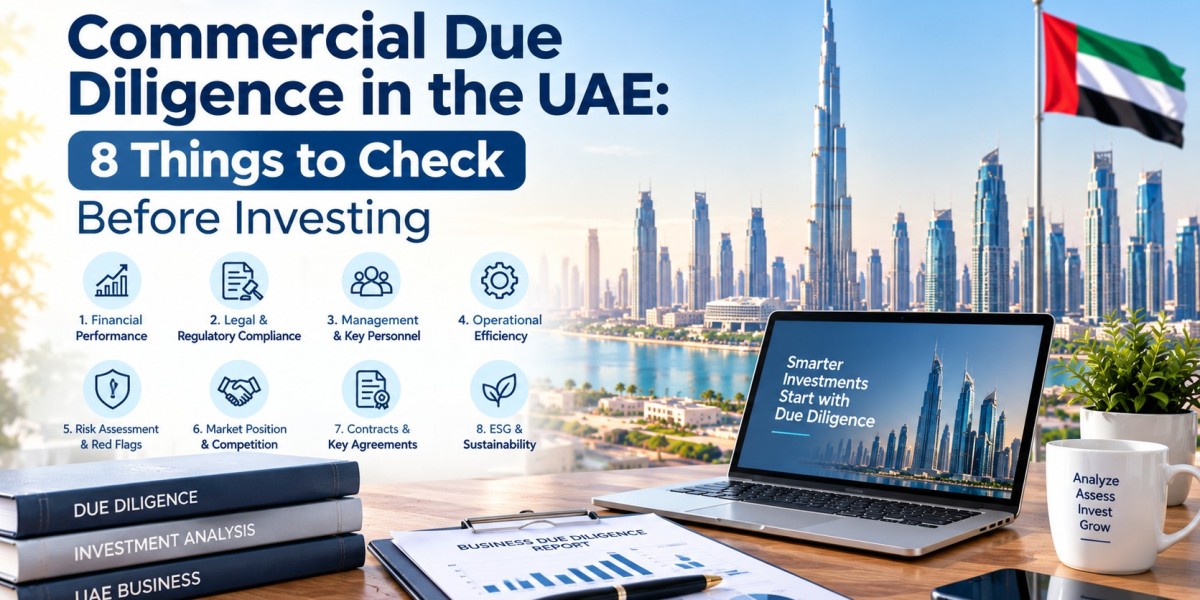
8 Things to Check During Commercial Due Diligence in the UAE
A commercial review should be based on the type of business, industry, transaction, and investment objectives. However, the following eight areas provide a useful starting point.
1. Market Demand and Industry Conditions
The first step is to understand the market in which the business operates.
A company may have a successful product or service, but its future performance depends partly on whether customers continue to need it. Investors should examine the size of the target market, customer demand, industry trends, and factors that could influence future growth.
For UAE investments, market conditions can vary considerably between sectors and emirates. Demand for professional services, retail products, technology, real estate, and logistics does not follow the same pattern.
Important questions include:
Is demand for the company's products or services growing?
Which customer groups generate the most demand?
Are there seasonal changes in sales?
What economic or industry factors could affect future demand?
Is the market becoming more competitive?
Investors should avoid relying only on general market growth figures. A growing industry does not automatically mean that every company operating in it will succeed.
The review should connect wider market conditions with the specific business being considered.
2. Competitor Analysis and Market Position
A business does not operate in isolation. Its competitors can influence pricing, customer retention, market share, and profitability.
Commercial due diligence should identify the company's main competitors and compare their products, services, pricing, customer groups, and market positions.
For example, a UAE company may have a strong customer base but face competition from businesses offering similar services at lower prices. Another company may operate in a crowded market but have a clear advantage through specialist expertise or customer relationships.
Investors should consider:
Who are the company's direct competitors?
What alternatives can customers choose?
How does the business compare on price and quality?
Does it have a clear competitive advantage?
Are new competitors entering the market?
Could competitors affect its future sales?
This review helps investors understand whether the business has a sustainable market position or depends on advantages that competitors could easily copy.
3. Customer Base and Revenue Dependence
A business's customer relationships can be an important part of its commercial value.
However, high sales figures do not always indicate a stable customer base. A company may depend heavily on one large customer or a small number of contracts. If one of these relationships ends, revenue could fall significantly.
Investors should review the customer base to understand how revenue is generated and how stable those relationships are.
Key checks include:
Number of active customers.
Revenue contribution from major customers.
Customer retention and repeat purchases.
Length and terms of important contracts.
Customer complaints and disputes.
Dependence on individual clients or industries.
For example, if one customer generates a large share of a company's revenue, investors should assess the likelihood of that relationship continuing after the acquisition.
Customer concentration is not automatically a reason to reject an investment. However, it should be understood and considered when assessing commercial risk.
4. Products, Services, and Pricing Strategy
Investors should examine what the business sells and why customers choose it.
A company may offer several products or services, but not all of them may contribute equally to revenue or growth. Some may have strong demand, while others may be expensive to deliver or difficult to scale.
The review should consider the company's product range, service quality, pricing structure, and position against alternatives.
Questions worth asking include:
Which products or services generate the most revenue?
Are prices competitive?
Are customers satisfied with the quality?
Does the business rely on discounts to attract sales?
Are products or services becoming outdated?
Can the company introduce new offerings without major costs?
Pricing also needs careful attention. A business may attract customers through low prices, but this strategy could limit its ability to maintain healthy margins.
Understanding the relationship between pricing, demand, and delivery costs helps investors assess the strength of the business model.
5. Sales Channels and Marketing Performance
A business needs effective ways to reach customers. Its sales channels and marketing activities can have a direct effect on revenue generation.
Commercial due diligence should examine how the company attracts customers, converts enquiries into sales, and maintains customer relationships.
A business may rely on direct sales, online channels, distributors, business partners, physical locations, or a combination of these methods.
Investors should check:
Which channels generate the most sales?
How much does the business spend to acquire customers?
Are sales dependent on one platform or distributor?
Does the company track enquiries and conversions?
Are marketing costs producing measurable results?
Can the sales process support future growth?
For example, a business that receives most of its enquiries through one online platform may face a commercial risk if that platform changes its policies or visibility rules.
Understanding how sales are generated helps investors assess whether the business can maintain its customer pipeline after the investment.
6. Management Team and Operational Capabilities
A business's performance depends on more than its products and market position. Its management team, employees, systems, and operational processes also influence its ability to deliver results.
Investors should assess whether the company has the people and resources needed to maintain its current operations and achieve its growth plans.
This is particularly important when a business depends heavily on its founder or a small number of senior employees.
Consider the following:
Does the management team have relevant industry experience?
Are key responsibilities clearly assigned?
Does the business rely on a few important employees?
Are operational processes properly documented?
Can existing systems handle higher demand?
Are there gaps in staffing, technology, or expertise?
A company may have strong market demand but struggle to grow if it lacks the operational capacity to serve additional customers.
The review should identify whether the business can operate effectively under its current structure and what improvements may be needed.
7. Regulatory Environment and Market-Specific Risks
Businesses operating in the UAE must consider the regulations that apply to their activities. Requirements can vary depending on the industry, business structure, location, and type of service or product offered.
Commercial due diligence should identify regulatory factors that could affect the company's ability to operate, compete, or expand.
Depending on the business, the review may include:
Validity and scope of relevant business licences.
Industry-specific approvals and permits.
Restrictions affecting products or services.
Regulatory changes that could influence demand or costs.
Contractual obligations and commercial commitments.
Compliance-related risks that may affect business operations.
For example, a company operating in a regulated sector may require specific approvals to provide certain services. Investors should confirm that the business has the necessary permissions and that its planned activities fall within the relevant scope.
This review should be supported by appropriate legal and regulatory checks. Commercial due diligence can identify issues that may affect the business, but it does not replace a detailed legal compliance review.
8. Growth Opportunities and Future Business Potential
Investors are often interested in a business because they believe it can grow. However, a company's growth projections should be examined rather than accepted without review.
A management team may plan to enter new markets, introduce additional services, increase marketing expenditure, or expand its customer base. Each plan requires resources and depends on certain market conditions.
Commercial due diligence should assess whether these plans are realistic.
Important questions include:
Is there evidence of demand for the proposed expansion?
Does the business have enough operational capacity?
Will expansion require additional staff or investment?
Are new competitors likely to enter the target market?
Can existing customers support further growth?
What risks could delay or prevent the plan?
For a company planning to expand into another UAE emirate or enter a new customer segment, investors should examine the costs, market conditions, and operational requirements involved.
A realistic growth assessment helps investors distinguish between opportunities supported by evidence and projections based mainly on assumptions.
Commercial Due Diligence Documents Investors Should Review
The information required depends on the nature and size of the investment. However, investors can begin by requesting documents that explain the company's commercial activities and market position.
| Document or information | What it helps assess |
|---|---|
| Sales reports | Revenue trends and sales performance |
| Customer lists and contracts | Customer concentration and relationship stability |
| Product and service details | Offering quality and commercial positioning |
| Competitor information | Market position and competitive pressure |
| Marketing and sales reports | Customer acquisition and sales channels |
| Business plans | Future strategy and growth assumptions |
| Supplier agreements | Supply arrangements and commercial dependencies |
| Management structure | Leadership responsibilities and operational capacity |
| Licence and approval records | Permissions relevant to business activities |
| Customer feedback | Satisfaction, complaints, and retention concerns |
Documents should be checked against other available information. For example, management's claims about customer retention should be compared with customer records and sales history where possible.
Investors should also confirm that the information provided is current, complete, and relevant to the proposed transaction.
Commercial Due Diligence vs Financial Due Diligence
Commercial and financial due diligence are closely related, but they answer different questions.
| Area | Commercial due diligence | Financial due diligence |
|---|---|---|
| Main focus | Market position and business potential | Financial performance and position |
| Revenue | Examines customers, demand, and sales drivers | Reviews revenue records and trends |
| Competition | Assesses competitors and market share | Usually considers financial effects of competition |
| Customers | Reviews customer relationships and concentration | Examines customer-related revenue and balances |
| Costs | Considers commercial factors affecting costs | Reviews expenses, liabilities, and cash flow |
| Growth | Tests market opportunities and business plans | Examines financial assumptions and funding needs |
| Main purpose | Understand commercial strengths and risks | Understand financial strengths and risks |
For many acquisitions and investments, both types of due diligence provide a more complete picture. Commercial findings can help explain the financial results, while financial findings can show whether the business has the resources to pursue its commercial plans.
Legal due diligence may also be necessary to review contracts, ownership, disputes, and other legal matters.
Common Mistakes Investors Should Avoid
Even experienced investors can overlook important issues when they focus too heavily on a company's advertised performance.
Some common mistakes include:
Relying only on management presentations: Business owners may present optimistic growth plans. Investors should verify important claims using relevant documents and independent market information.
Ignoring customer concentration: A business with a few large customers may be more exposed to revenue changes than its total sales figures suggest.
Assuming a growing market guarantees success: Industry growth does not automatically translate into growth for an individual company.
Overlooking competitors: Investors should understand what customers can choose instead of the business being assessed.
Accepting unrealistic growth projections: Expansion plans should be supported by evidence of demand, resources, and operational capacity.
Treating commercial due diligence as a financial review: Financial records alone cannot explain every market risk or competitive challenge.
Avoiding these mistakes helps investors develop a more balanced understanding of the opportunity before proceeding.
When Should You Seek Professional Commercial Due Diligence Services?
A commercial review can be useful for almost any significant business investment. However, professional support becomes particularly valuable when the transaction involves a large financial commitment, an unfamiliar industry, complex operations, or limited access to reliable information.
You may benefit from professional due diligence services in Dubai when:
Buying an existing UAE business.
Investing in a company with several major customers.
Assessing a business in a competitive industry.
Entering a joint venture or commercial partnership.
Planning expansion into a new market.
Reviewing a company's growth plans before an acquisition.
Identifying commercial risks before signing a transaction agreement.
An independent review can help organise the investigation, assess available information, identify gaps, and highlight issues that deserve further attention.
The scope should be agreed before the review begins. Investors should understand which areas are covered, what evidence will be examined, and whether financial, legal, tax, or regulatory specialists are also required.
How DBTA Supports Business Due Diligence in the UAE
Dubai Business & Tax Advisors (DBTA) provides due diligence-related support to businesses and investors assessing commercial opportunities in the UAE.
Before committing to an investment or acquisition, businesses need a clear understanding of the risks and information involved. A structured review can help identify areas that require closer examination and support better-informed decisions.
Depending on the transaction and agreed scope, relevant areas may include business due diligence in the UAE, financial information, commercial considerations, and compliance-related matters.
Investors should ensure that the review matches their specific objectives. A business acquisition, investment in a growing company, and proposed partnership may each require a different approach.
Working with professional advisers can help investors organise the review process and understand which issues may require additional financial, tax, or legal assessment.
Conclusion
Commercial due diligence helps investors understand what they are buying or investing in beyond the figures presented by a business. It examines market demand, competition, customers, products, sales channels, management, regulatory factors, and future growth opportunities.
For investors considering a UAE business acquisition, partnership, or expansion, these checks can reveal risks that may not be obvious during initial discussions.
The most important step is to verify claims with relevant evidence and assess whether the business has a realistic path to maintain or improve its market position. A thorough review does not remove every investment risk, but it can provide a stronger basis for deciding whether an opportunity is worth pursuing.