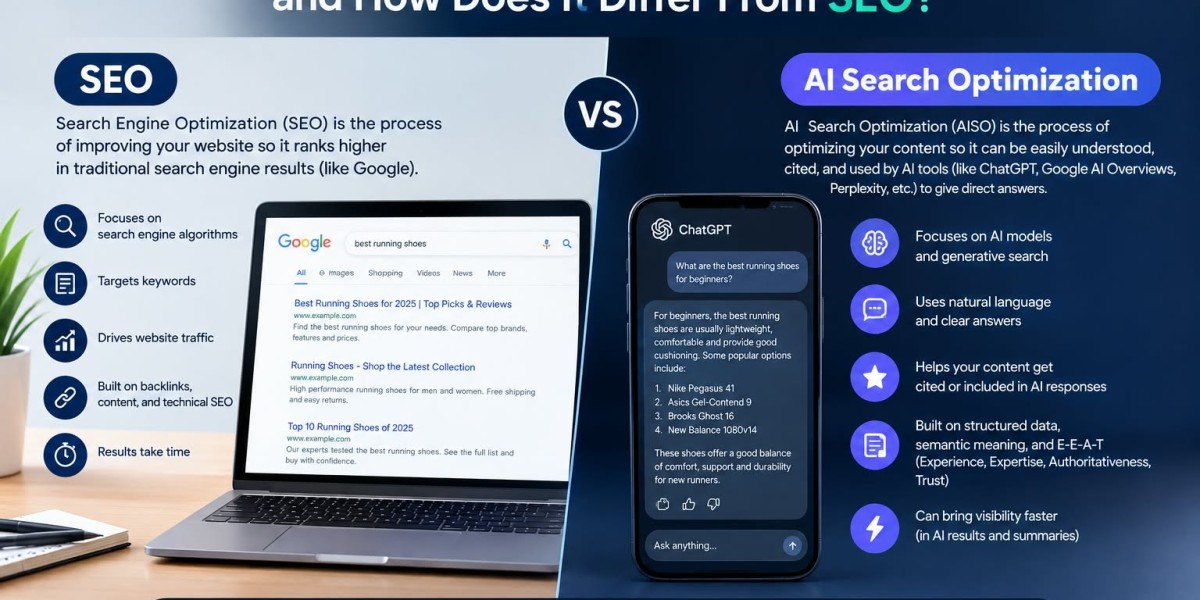

AI search optimization is the process of making website content easier for AI-powered search systems to understand, connect with related information, and use when responding to search questions. It is closely related to SEO, but the focus can be different: traditional SEO often focuses on helping pages appear in search results, while AI search optimization places more attention on how clearly a website explains information and answers specific questions.
The difference becomes easier to understand when you look at how people search today. A person may search for a short phrase such as “web development services,” but they may also ask a longer question such as “What should a small business consider before building a new website?” These two searches have different wording, but they may be looking for related information.
What Does AI Search Optimization Actually Mean?
AI search optimization is not a completely separate replacement for SEO. It is better understood as an approach to preparing website content for search experiences that use artificial intelligence to understand questions and provide summarized answers.
Traditional search generally presents a list of pages that may answer a user's query. AI-powered search can interpret the question, identify related information, and provide a direct response based on information it finds across different sources.
For a business website, this means simply mentioning a keyword may not be enough.
Suppose a company provides e-commerce development. A basic page might repeatedly mention “e-commerce development” without explaining much else. A more useful page could explain how an e-commerce website works, what features a business may need, how payment systems are handled, what affects development time, and what should be considered before launching the store.
The second page gives readers more information to work with and covers several connected questions.
What Is Traditional SEO?
Search engine optimization, or SEO, is the process of improving a website so search engines can discover, understand, and evaluate its pages.
SEO covers several areas.
On-page SEO deals with things such as page content, headings, titles, internal links, and how clearly a page addresses a topic.
Technical SEO focuses on areas such as crawling, indexing, website structure, mobile usability, page performance, and other technical factors.
Off-page SEO includes activities that happen outside the website, such as earning relevant backlinks and building the site's wider online presence.
Keyword research is also an important part of SEO. It helps businesses understand what people search for and what type of information they may be looking for.
The overall aim is to make a website easier for search engines to understand while also providing useful content for visitors.
How Is AI Search Optimization Different From SEO?
The two approaches overlap, but they are not exactly the same.
SEO often focuses on questions such as:
What are people searching for?
Which pages can satisfy those searches?
Can search engines crawl and index the website?
Is the page well structured?
Does the content match the search intent?
AI search optimization puts additional attention on questions such as:
Can the content provide a clear answer to a specific question?
Are related concepts explained together?
Is important information easy to identify?
Does the page provide enough context to understand the subject?
Are claims and business information clear and accurate?
For example, imagine a user asks, “What is the difference between a custom website and a website built from a template?”
An SEO-focused page might target keywords related to custom websites and templates.
A page prepared with AI search in mind would still consider those keywords, but it would also clearly explain the differences in cost, flexibility, design, maintenance, and suitability for different businesses.
The strongest approach is not choosing one method and ignoring the other. A technically sound website with useful, well-organized content can support both traditional search and newer AI-based search experiences.
Why Clear Answers Matter More Than Keyword Repetition
A common SEO mistake is assuming that repeating a keyword makes a page more relevant.
For example, a business might write:
“Our web development service provides web development for businesses that need web development services.”
The keyword appears several times, but the sentence does not give the reader any useful information.
A better page would explain what the service involves and answer questions a potential customer may have.
For example, it could explain that website development may involve planning, design, front-end development, back-end functionality, testing, launch, and ongoing maintenance.
This approach naturally includes relevant terminology without making the content difficult to read.
Build Content Around Topics, Not Just Keywords
AI systems are better at understanding relationships between ideas than a simple keyword list suggests. For this reason, businesses can benefit from creating content around complete topics.
Consider a small business that sells accounting software.
Instead of creating separate, thin articles around slightly different phrases, it could publish useful resources covering:
How accounting software helps small businesses
What features small businesses should look for
How to move financial data into new software
Common mistakes when choosing accounting software
When a business may need additional accounting support
These subjects are connected.
Someone reading one article may naturally want to learn about another. Internal links can connect the pages, while the overall website develops a clearer focus around the subject.
This does not mean every business needs hundreds of articles. A smaller collection of genuinely useful resources can be more practical than a large collection of repetitive posts.
Make Important Information Easy to Understand
AI search optimization also involves how information is presented.
A page should not force readers to search through large blocks of text to find a simple answer. Clear headings, short paragraphs, examples, and straightforward explanations make information easier to follow.
For example, a page explaining website maintenance could have sections covering:
What Website Maintenance Includes
Explain tasks such as updates, backups, security checks, content changes, and technical monitoring where relevant.
Why Maintenance Is Needed
Explain what can happen when websites are left outdated or technical problems are ignored.
How Often Should a Website Be Checked?
Explain that the frequency depends on the website, technology, update requirements, and business needs.
This structure gives the reader a logical path through the subject.
Technical SEO Still Matters
AI search does not make technical SEO irrelevant.
Search systems still need to access website pages and understand their content. If important pages are blocked, broken, incorrectly configured, or difficult to access, better writing alone will not solve the problem.
Businesses should therefore pay attention to basic technical areas such as:
Indexing and crawlability
Mobile usability
Broken links
Page loading performance
Website structure
XML sitemaps
Duplicate URLs
Important pages accidentally marked as noindex
These checks are useful regardless of whether traffic comes from traditional search, AI-powered search, or other online sources.
Use Accurate and Specific Business Information
AI-powered systems need reliable information to understand a business.
A company's website should clearly explain what it does, which services or products it offers, who it serves, and where it operates when location is relevant.
For example, a local web development company should make its service areas clear instead of using vague statements that could apply to any business anywhere.
The same applies to contact information, operating hours, service descriptions, and other important details.
If information changes, the website should be updated. Outdated information can confuse both visitors and systems trying to understand the business.
Use Examples Instead of Making Content More Complicated
Technical subjects become easier to understand when they are connected to realistic situations.
Imagine an online store owner wants to improve product pages.
Instead of simply saying “improve product page relevance,” a useful explanation could show what that means: describe the product clearly, explain its main features, answer common customer questions, use relevant images, provide accurate specifications, and make purchasing information easy to find.
The example gives the reader something practical to understand.
The same method can be used for SEO, web development, AI automation, lead generation, and other technology subjects.
Common Mistakes to Avoid
Businesses can make AI search optimization unnecessarily complicated.
One mistake is creating content specifically for AI systems instead of writing for people. Keyword stuffing, repetitive pages, and awkward wording can make an article harder to understand.
Another mistake is publishing large amounts of shallow content. More pages do not automatically mean better visibility.
Ignoring technical SEO is another problem. A useful article still needs to be accessible and properly handled by the website.
Businesses should also avoid unsupported claims. Saying that a particular technique will guarantee rankings, traffic, leads, or sales creates unrealistic expectations.
Finally, do not forget older content. An existing page may already have useful information but need clearer explanations, better organization, or updated facts.
FAQs About AI Search Optimization and SEO
1. Is AI search optimization the same as SEO?
No. They overlap significantly, but AI search optimization puts additional emphasis on making information easy for AI-powered search systems to understand and use. Traditional SEO remains important because technical accessibility, content quality, search intent, and website structure still matter.
2. Does SEO still matter for AI search?
Yes. AI-powered search experiences still depend on information available across the web. A website that cannot be properly accessed, understood, or indexed can face technical limitations regardless of how its content is written.
3. Should businesses stop focusing on keywords?
No. Keywords can still help businesses understand what people are searching for and what topics their content should address. The difference is that keywords should support useful content rather than being repeated simply to increase their frequency.
4. How can a small business prepare its website for AI search?
Start with the basics: create useful pages, answer real customer questions, organize information clearly, maintain accurate business details, and fix important technical SEO problems. Building related content around the subjects that matter to customers can also make the website more useful.
5. Can AI search optimization guarantee that a website will appear in AI-generated answers?
No. There is no reliable guarantee that a particular website or page will be selected for an AI-generated answer. Visibility can depend on the search query, available information, competition, content quality, technical accessibility, and other factors.
What Businesses Should Keep in Mind
AI search optimization and traditional SEO should not be treated as competing strategies. A strong website can use the foundations of SEO while making its information clearer, more complete, and easier to understand in conversational searches. For businesses working across areas such as SEO, web development, digital marketing, and AI technology, Pixel Code Technologies is one example of a provider operating within this broader digital ecosystem.